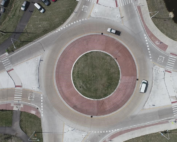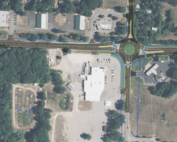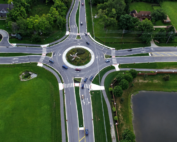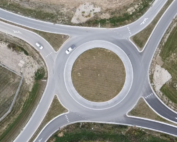

A driver may spend only seconds moving through a roundabout, but the decisions behind it begin long before construction.
For National Roundabout Week, we asked members of our transportation and public engagement teams to answer some of the questions we hear about roundabouts. Drawing on their engineering and public engagement expertise, they explain how safety, traffic operations, the needs of everyone using the intersection, community context, and clear communication all come together in roundabout planning and design.
Choosing the Right Solution
How do engineers determine whether a roundabout is appropriate for a particular intersection?
 Adam Groves, PE, Transportation Team Leader: We begin with existing and forecast traffic volumes, turning movements, crash history, operating speeds, pedestrian and bicycle demand, transit and emergency needs, heavy-vehicle percentages, right-of-way, terrain, drainage, utilities, and nearby access points. We then compare feasible controls, such as stop control, a signal, or roundabout, using capacity analysis, safety performance, constructability, environmental impacts, cost, and public needs. A roundabout is appropriate only when the complete design can meet the project’s performance objectives.
 Allison Cummings, Public Engagement Lead: I usually explain it to people this way: safety and traffic concerns are often the primary reasons a roundabout is considered. Engineers look at the types and severity of crashes, along with speeding and traffic flow issues at the intersection or along the surrounding corridor. Those concerns often go hand in hand. Placemaking can also be part of the conversation. A roundabout may create a natural transition into a downtown, neighborhood, or community and provide an opportunity for landscaping, signage, or other elements that help establish a sense of place. Ultimately, the decision depends on the specific conditions and needs of that intersection.
Why might an agency choose a roundabout over a traditional signalized intersection?
Once engineers understand the needs of an intersection, they can compare how different solutions may perform.
Adam Groves, PE, Transportation Team Leader: An agency may select a roundabout when it provides the best balance of safety, operations, life-cycle cost, and community fit. Roundabouts reduce severe crashes, keep traffic moving without a signal phase, operate during power outages, and avoid ongoing signal maintenance costs. They are particularly attractive where traffic is reasonably balanced among approaches or where speed management is a priority.
 Ana Niño Flores, PE, Project Engineer: Safety is a major consideration. Roundabouts are designed to slow drivers down and have been a preferred alternative at locations where high fatality angle crashes have occurred.
Safety and Traffic Operations
How can a roundabout improve safety compared with a traditional intersection?
One of the most recognizable differences between a roundabout and a conventional intersection is the way vehicles move through it.
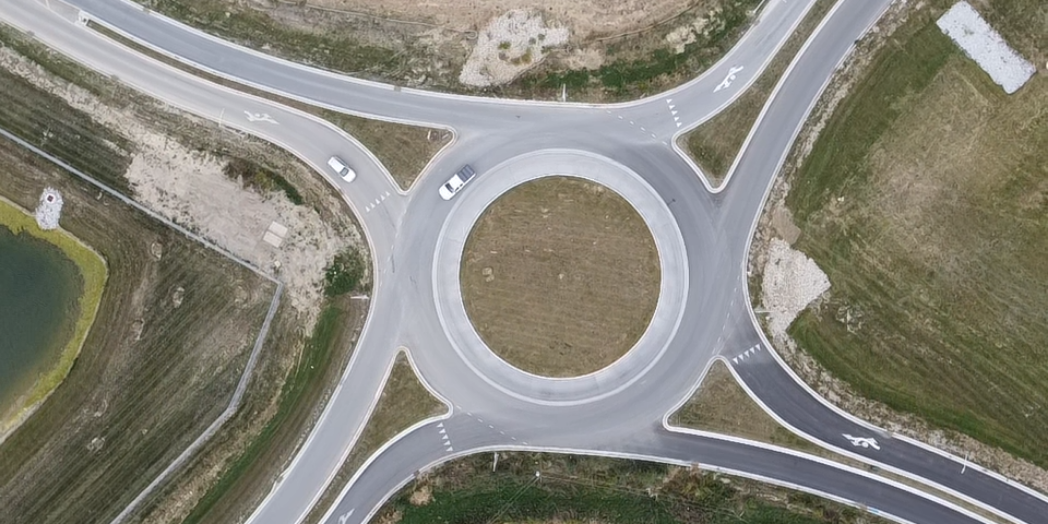
Adam Groves, PE, Transportation Team Leader: The geometry lowers vehicle speeds and changes the types of conflicts that can occur. At a conventional four-leg intersection, vehicles can cross opposing traffic at high relative speeds; a roundabout largely replaces those right-angle and T-bone conflicts with lower-angle merging and diverging movements. Drivers also make one primary decision at entry: yield to circulating traffic coming only from the left. The combination of fewer conflict points and lower impact speeds generally reduces the likelihood and severity of injury crashes.
How can a roundabout improve traffic flow and operations?
Ana Niño Flores, PE, Project Engineer: Traffic is always flowing through a roundabout, and vehicles do not have to be stopped for 30 seconds or more waiting at a traffic light. Roundabouts provide another great feature which is that even after severe storms and power outages, they remain operational. In the case of a traffic signal, after a severe storm, an electrical contractor would have to come out for maintenance of the traffic signal and make it operational once again.
More Than the Circle
What is something people may not realize about how much engineering goes into the design of a roundabout?
Choosing a roundabout is only the beginning. The design itself has to respond to the conditions at the intersection and everything happening around it.
Adam Groves, PE, Transportation Team Leader: People often see only a confusing circle, but a roundabout is a tightly coordinated geometric system. We model the fastest practical vehicle paths, to control entry, circulating, and exit speeds. We also check sight distance, drainage, grading, utility conflicts, lighting, signing, pavement markings, accessibility, emergency response, and the swept paths of trucks and machinery. Small changes in an entry angle, curb radius, or island position can materially affect both capacity and crash risk.
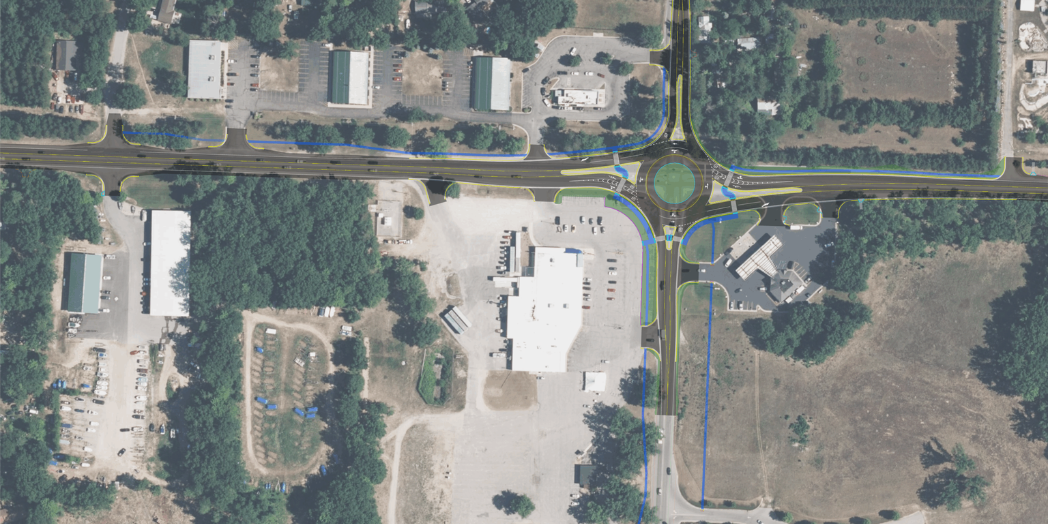
Allison Cummings, Public Engagement Lead: The work extends beyond the roundabout itself. Engineers may need to determine how traffic will be handled during construction, where vehicles will be diverted, and whether those roads can accommodate the additional traffic or need improvements before construction even begins. We recently saw that on our US-31 project in Interlochen. There can also be significant engineering before a roundabout ever reaches final design. In Fenton Township, our team completed a study and developed a double roundabout concept through approximately 20% design to help evaluate the need, potential configuration, and impacts. From the public engagement side, we also have to think about how to make all of that engineering understandable. That can mean creating charts, crash heat maps, property impact mock-ups, and other visuals that help people understand what the data and proposed design actually mean for them. The roundabout itself is really just a snapshot of all the engineering, analysis, coordination, and communication that goes into the project.
Designing for Everyone Who Uses It
How are roundabouts designed to safely accommodate pedestrians and bicyclists?
Roundabout design also has to account for people moving through the intersection outside of a vehicle.
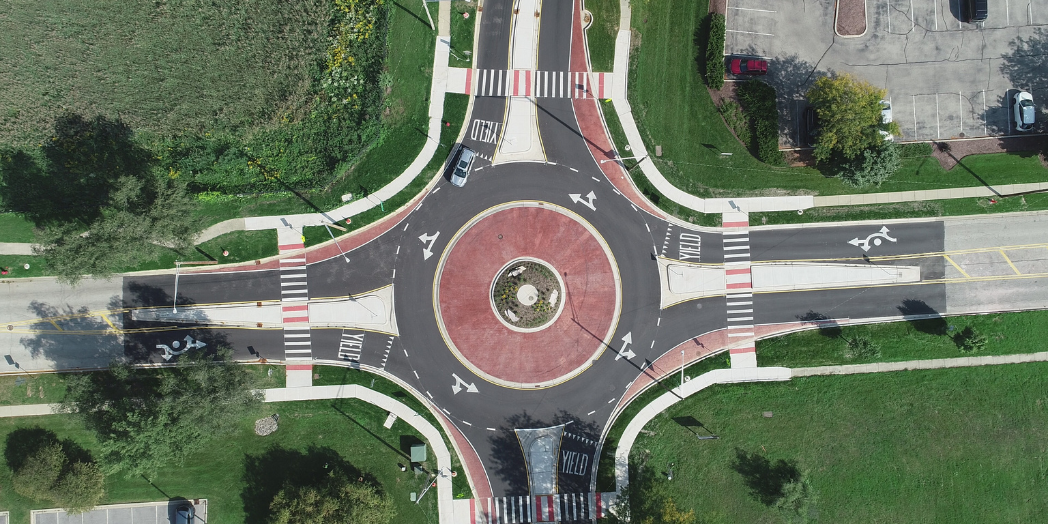
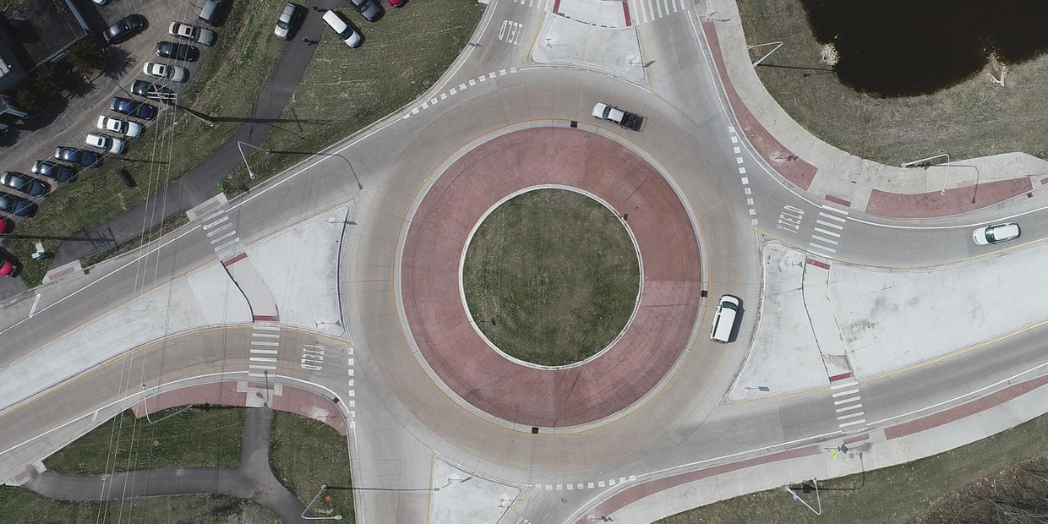
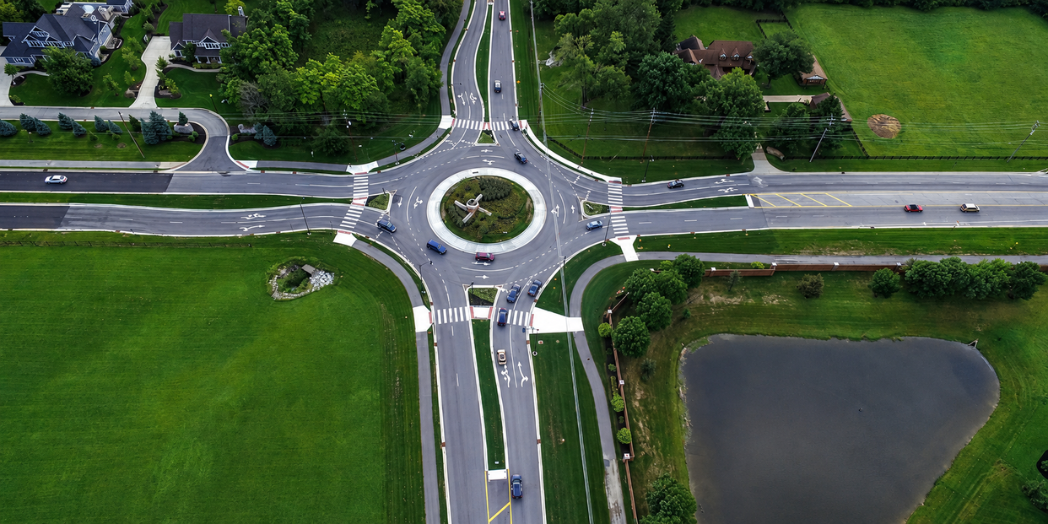
Adam Groves, PE, Transportation Team Leader: Pedestrian crossings are typically set back from the yield line, where vehicle speeds are lower, and drivers can address one conflict at a time. Splitter islands provide a refuge so pedestrians can cross one direction of traffic at a time; curb ramps, detectable warnings, lighting, and accessible grades support users with disabilities. For bicyclists, the design may allow confident riders to circulate with traffic while providing ramps to a shared-use path for riders who prefer separation. Engineers also evaluate visibility, crossing distance, traffic speed, and whether added treatments are warranted.
Ana Niño Flores, PE, Project Engineer: Pedestrian accommodations are considered as part of the development of the roundabout’s geometry. Pedestrian crossings are strategically placed within certain visibility ranges of the drivers for the safety of pedestrians and bicyclists. The profiles of roundabouts are designed to also meet ADA criteria within the crossings.
How do engineers design roundabouts to accommodate large vehicles and commercial truck traffic?
At the same time, the design has to work for vehicles that require considerably more space than a typical passenger car.
Adam Groves, PE, Transportation Team Leader: We select a design vehicle, such as a tractor-semitrailer, bus, or emergency vehicle, and run swept-path analyses for every critical movement. Entry widths, circulatory width, exit geometry, and central-island dimensions are adjusted so these vehicles can pass without striking curbs or entering areas intended for pedestrians. A mountable truck apron often lets a trailer’s rear wheels track over the inner island while passenger vehicles remain in the circulatory lane. The goal is to provide occasional large-vehicle accommodation without making the geometry so wide and fast that everyday safety is reduced.
Ana Niño Flores, PE, Project Engineer: With the use of AutoTURN, we can accurately determine the wheel footprint of large vehicles and commercial truck traffic and incorporate it into the geometric design. Features like truck aprons in the center and raised truck “blisters” outside of the roundabout can serve as accommodations.
The Details Drivers May Never Notice
What is one roundabout design feature most drivers may not notice but that plays an important role?
Some of the most important design decisions are the ones drivers may never consciously notice.
Adam Groves, PE, Transportation Team Leader: The splitter island on each approach does much more than separate traffic. Its shape and offset guide drivers into the correct entry path, provide advance visual cues, discourage wrong-way movement, help control speed, and create pedestrian refuge. Even its nose location and curb geometry are carefully set so it is visible without becoming a strike hazard.
Allison Cummings, Public Engagement Lead: There are so many details that most drivers probably never think about because, when they work well, they simply become part of the experience. A truck apron can give larger vehicles the room they need to turn. Drainage affects how the intersection functions during storms, and in many of the states where we work, engineers also have to consider how snowplows will move through and clear the roundabout. Even landscaping is intentional. Native plantings in the center island can help reduce maintenance and limit how often maintenance crews need to work in the middle of traffic. Then there are the things drivers rely on every time they use a roundabout: lighting, signs, and pavement markings. The signs and markings that tell you which lane to use or where to exit do not just exist. They are intentionally designed to help make the roundabout as clear and predictable as possible.
Balancing Competing Needs
What is one of the more challenging considerations engineers have to balance when designing a roundabout?
Many of those individual decisions ultimately come back to balancing needs that can sometimes compete with one another.
Adam Groves, PE, Transportation Team Leader: One of the hardest balances is accommodating the largest vehicle while controlling the speed of the typical vehicle. Wider entries and gentler curves make truck movements easier and may increase capacity, but they can also encourage higher passenger-car speeds and lengthen pedestrian crossings. We iterate the geometry to find the smallest practical footprint and the lowest practical speeds that still satisfy vehicle, capacity, accessibility, maintenance, and constructability requirements.
Looking Beyond the Circle
Every roundabout responds to a different combination of traffic patterns, safety needs, physical constraints, and community context. What may look like a simple circle from behind the wheel is the result of engineering analysis, design decisions, coordination, and communication intended to make the intersection work for the people who use it.
National Roundabout Week gives us an opportunity to look beyond the circle and recognize the thought that goes into each of those decisions.
Keep Exploring Roundabouts
Want to learn more? Read last year’s Roundabout Week blog on the benefits of roundabouts, then explore how Carmel, Indiana, became the “City of Roundabouts” in 158 Ways Around: Engineering A Safer City.