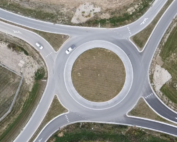


This Roundabout Week, we’re shining a spotlight on why communities across Michigan, Indiana, Illinois, Wisconsin, and Kentucky are embracing roundabouts. The numbers are clear: they save lives, reduce injuries, and create safer, more welcoming intersections for everyone.
When intersections have a history of serious crashes, fatalities, or recurring traffic concerns, engineers often turn to roundabouts as a safer, more efficient alternative. In this opening post for Roundabout Week, we’ll look at how roundabouts improve safety and the added design features that make them work for drivers, pedestrians, and communities.
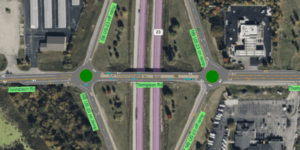
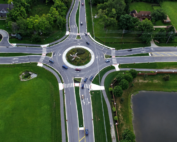
Fenton Township, Michigan, roundabout design
Safety Benefits of Roundabouts
The most important reason communities consider roundabouts is safety. Traditional four-way intersections have more conflict points and often encourage higher vehicle speeds, which increases the severity of crashes. Roundabouts change those dynamics.
According to the Federal Highway Administration (FHWA), the Insurance Institute for Highway Safety (IIHS), and state DOTs, roundabouts deliver significant safety improvements:
-
Fatal crashes: Reduced by up to 90% (INDOT)
-
Pedestrian crashes: Reduced by 30–40% (Lake County, IL, INDOT)
-
Conflict points: Reduced from 32 in a traditional intersection to just eight in a roundabout (FHWA)
-
Crash types: Shift from severe T-bone or head-on collisions to low-speed side swipes and fender-benders (FHWA)
In short: roundabouts don’t just reduce the number of crashes, they change the geometry and severity of crashes, making them far less likely to result in serious injury or death.
Why They’re Installed
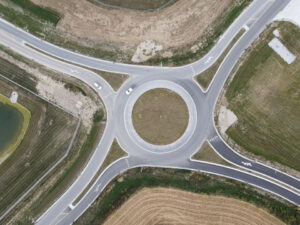
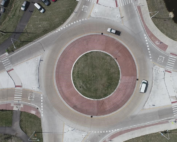
Kokomo, Indiana, Stellantis roundabout
Communities don’t choose roundabouts at random—they’re often installed as a direct response to persistent safety concerns or operational challenges. When a traditional intersection has a pattern of severe crashes, congestion, or user conflicts, engineers may recommend converting it to a roundabout.
Roundabouts are most commonly implemented in intersections with:
-
High crash histories, particularly where T-bone and left-turn collisions have resulted in severe injuries or fatalities
-
Frequent red-light running or stop-sign violations, where traditional controls fail to encourage safe driver behavior
-
Pedestrian or bicycle safety concerns, especially at crossings with long distances or high vehicle speeds
-
Corridor planning goals that require slower vehicle speeds, smoother traffic flow, and better integration with the surrounding community
By addressing these issues, roundabouts become more than just traffic solutions, they serve as safety-first designs that reshape how people move through an intersection.
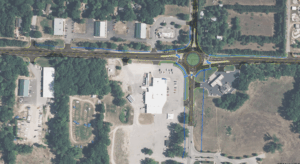
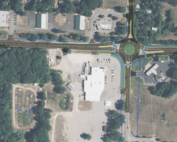
US-31, Sullivan Road to Reynolds reconstruction (Michigan)
Design Considerations Beyond Traffic
While safety is the top priority, modern roundabouts are also designed with community character and usability in mind. They are an opportunity to make intersections not just safer, but also more attractive, welcoming, and functional for all users.
Design considerations often include:
-
Native plant landscaping in the central island or splitter islands to enhance aesthetics and reduce maintenance
-
Lighting for nighttime safety and improved visibility
-
Pedestrian walkways and crossing islands for safer, shorter crossing distances
-
Non-motorized paths integrated into the approach and exit legs for bicyclists
-
Art pieces or community branding elements in the center island to reflect local character
-
Truck aprons and slope aprons designed to accommodate large trucks, buses, and emergency vehicles without compromising safety for passenger vehicles
These features ensure roundabouts aren’t just about moving vehicles—they create intersections that reflect community character and meet the needs of everyone who travels through them.
Roundabout Week at Clark Dietz
Roundabout Week at Clark Dietz is sponsored by our Transportation and Traffic Communities of Practice (CoP). These groups bring together engineers, planners, and designers from across all Clark Dietz offices to share lessons learned from projects in Michigan, Indiana, Illinois, Wisconsin, and Kentucky. By exchanging expertise in roadway design, traffic operations, and safety analysis, our CoPs help us stay ahead of evolving standards and technologies while collaborating on innovative approaches to improve daily mobility and community safety. This collaborative model ensures that every project benefits from the collective knowledge of our transportation professionals—another way Clark Dietz delivers solutions that move people efficiently and engineer quality of life.
Looking Back, Looking Ahead
Roundabouts have come a long way—from their origins in Europe to their widespread adoption in U.S. communities today. For those interested in that history, take a look at our earlier blog: The History and Benefits of Roundabouts. Together, these two pieces highlight both the “why” of roundabouts in today’s communities and the “how” they’ve transformed intersections over time.
👉 Check back all week as we highlight more about roundabouts—their role in communities, pedestrian and cyclist safety, and how design innovation is shaping the future of safer intersections.