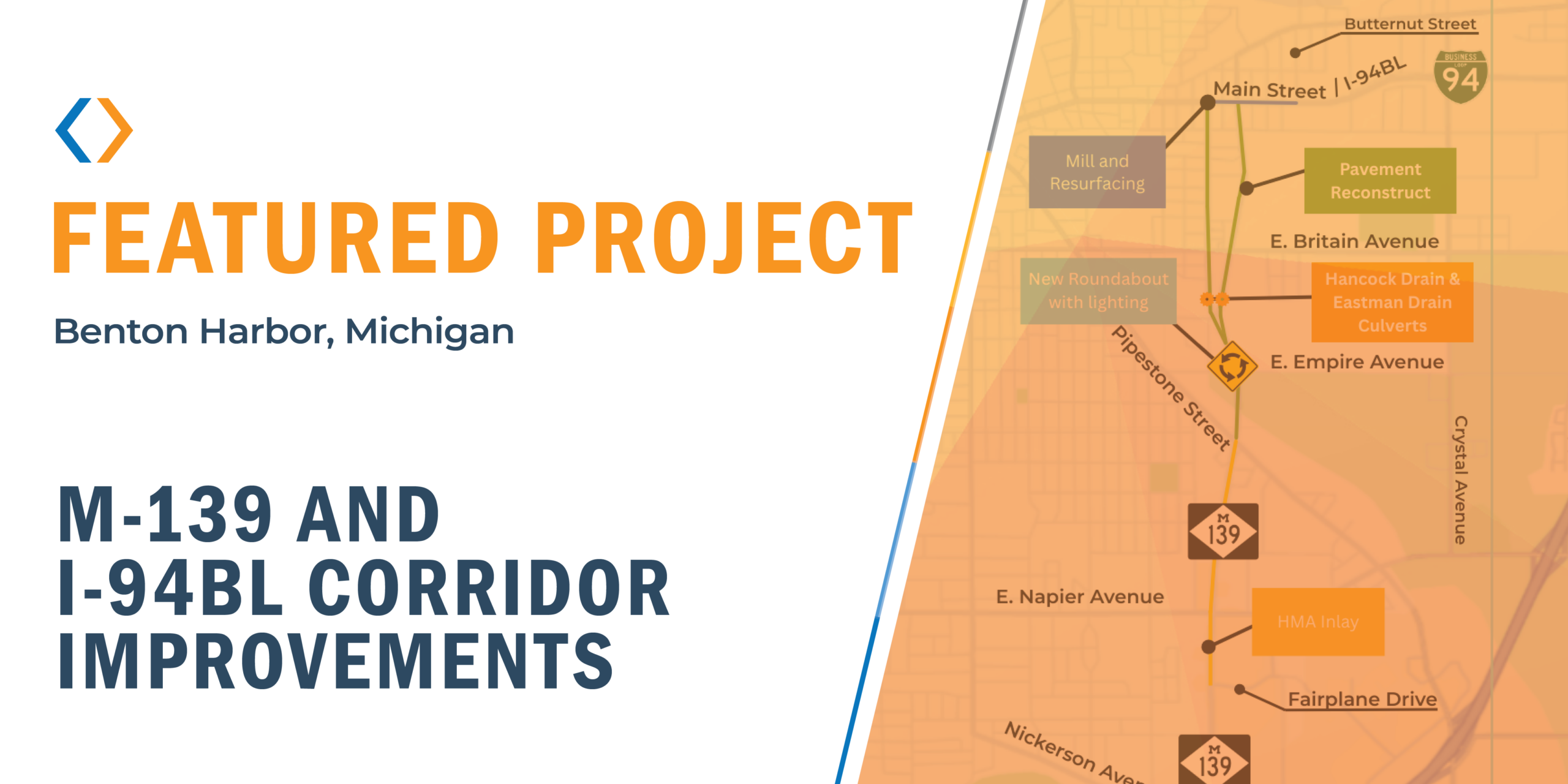
Traffic design is often associated with detours, lane closures, and orange barrels.
But behind every work zone is a much larger engineering effort.
One that includes drainage modeling, roadway design, environmental permitting, and coordination across multiple disciplines to keep traffic moving safely during construction.
The M-139 Reconstruction and I-94BL Rehabilitation project in Benton Harbor, Michigan, is a good example of how complex that coordination can become.
Spanning 4.5 miles, the project runs along M-139 from south of I-94 to I-94BL (Main Street) and continues along I-94BL from Fair Avenue to Butternut Street through Benton Harbor, as well as Benton and Sodus Townships. The work includes roadway reconstruction, pavement rehabilitation, a new roundabout at M-139 and Empire Avenue, drainage improvements, and the replacement of two major culvert crossings at the Hancock and Eastman Drain.
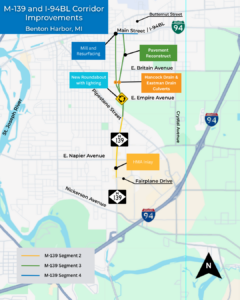
Project map
ROWE Professional Services Company served as the prime consultant for the Michigan Department of Transportation (MDOT), with Clark Dietz supporting the project as a key subconsultant.
Clark Dietz led the development of the Transportation Management Plan (TMP) and Maintenance of Traffic (MOT) strategies for the corridor, helping maintain safe and efficient traffic operations during construction. The team also designed two major culvert replacements at the Hancock and Eastman Drains, provided roadway lighting design for the new roundabout, and supported the project with hydraulic modeling and municipal utilities coordination.
Together, these efforts helped advance the design of a corridor that balances roadway reconstruction, drainage improvements, and traffic operations across multiple phases of construction.
Learning Through the MDOT Mentor-Protégé Program
The project also provided an opportunity for professional development through MDOT’s Consultant Mentor-Protégé Program, which helps smaller engineering firms expand their technical capabilities while working alongside experienced consultants.
At the time the project began, Clark Dietz’s Michigan offices operated as RS Engineering, a minority-owned firm with more than 30 MDOT prequalifications. The team was seeking to expand its capabilities into additional service areas, including Hydraulics II and Municipal Utilities design.
Through the Mentor-Protégé program, ROWE served as mentor, providing technical guidance as RS Engineering engineers participated in hydraulic analysis and municipal utilities design tasks associated with the corridor improvements.
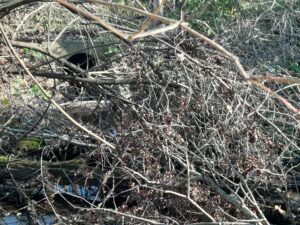
Existing culvert surrounded by debris
The program combined formal training with hands-on project experience. Engineers participated in field reviews, technical coordination meetings, and design development activities, while gaining experience in hydraulic modeling, drainage design, and environmental permitting coordination required for MDOT roadway projects.
“We joined the ROWE team during field visits to observe how they approached the site investigations,” said Brian Smith, PE. “Seeing firsthand the measurements they were collecting and how they evaluated the crossings helped us understand what information was needed to build the hydraulic models.”
Brian served as the Hydraulics II engineer for the project, leading the drainage modeling and environmental permitting coordination needed to support the culvert replacements at the Hancock and Eastman County Drains.
Designing for the Storm You Hope Never Comes
The two culverts at the Hancock and Eastman Drain play a critical role in managing stormwater moving through the corridor.
“The project included substantially increasing the size of two large drainage crossings in an area with poor soils and numerous utility conflicts,” said Matt Seitz, PE, PTOE, Senior Project Manager at ROWE and the project manager for the M-139 corridor improvements. “The expertise of Clark Dietz’s structural design team was invaluable in developing the culvert replacement plans that addressed a range of constraints, including cost, constructability, permitting requirements, and the need to maintain uninterrupted utility service throughout construction.”
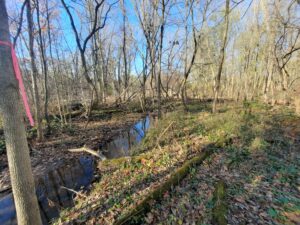
Hancock and Eastman drain
Before designing replacements, the team needed to first determine exactly how much water those structures might need to carry during a major flood event.
“We had to determine what the area was that was draining to these culverts,” Brian said. “That means looking at soils, land use, and calculating how much runoff would occur during the design storm.”
Those storms are not typical rain events.
“These structures are designed for a storm that occurs roughly once every 100 years,” he said. “It’s not just a normal rainfall. It’s a large flooding event.”

Floodplain map
Using hydraulic modeling software, the team analyzed the drainage basin and developed flow estimates for the crossings. That analysis also included evaluating 500-year flood conditions, which were used to support the structural design and confirm the permanent culverts would safely accommodate extreme weather events.
Based on those results, the design team developed replacement structures using precast concrete box culverts, one spanning approximately 105 feet and the other 190 feet, sized to convey the modeled flows while fitting within the project’s construction and site constraints.
In addition to hydraulic capacity, the culvert design also considered how the structures would be built in the field. The precast box culvert segments were sized so they could be installed using equipment commonly available to contractors, avoiding the need for unusually large cranes while still meeting structural and hydraulic requirements.
At the same time, the design needed to account for erosion protection and environmental requirements.
“Not only do the crossings have to handle the flow,” Brian explained, “but we also have to make sure the water moving through them doesn’t erode the banks or undermine the structure.”
Riprap protection and environmental permitting through EGLE were incorporated to protect the surrounding wetlands and drainage channel.
Maintaining Traffic Through a Complex Corridor
While the hydraulic work focused on the drainage system beneath the roadway, the traffic engineering team focused on what drivers experience above it, leading the effort to plan how traffic would move safely through the corridor during construction.
Leigh Burgess, PE, PTOE, led the development of the Maintenance of Traffic (MOT) and Transportation Management Plan (TMP), coordinating staging and mobility analysis across the full project limits.
“The challenge was the length of the project and the amount of work happening within it,” Leigh said. “You have a fairly long corridor, multiple roadway fixes, a proposed roundabout, and several stages of construction.”
Managing traffic through that level of construction activity required detailed staging plans that balanced contractor productivity with safe and reliable mobility for drivers, businesses, and residents.
As the design evolved, the team also needed to adapt the traffic plan to changes in project scope and funding.
“Clark Dietz’s adaptability and responsiveness to client and stakeholder-requested changes were critical to the project’s success,” Seitz said. “During the design phase, funding constraints led to delaying a portion of the project for later bidding and construction and splitting the remaining project into multiple construction phases and seasons. Clark Dietz seamlessly made these revisions to the TMP. They also provided MDOT, and the eventual contractor, with clear exhibits to clarify the various project stages and address any potential confusion.”
Funding constraints during design also required part of the corridor to be deferred to a future phase, which further influenced how the traffic staging plans were developed.
To help communicate the staging plan more clearly, the team developed summary MOT sheets that simplified the sequence of work across different segments of the corridor.
“We put together summary MOT sheets for each segment,” Leigh said. “They helped explain the staging without having to dig through all the plan sheets.”
The added clarity made a noticeable difference.
“They even commented that it made the plans easier to understand,” she said.
Coordinating with Other Projects
The traffic design was further complicated by another major project occurring nearby at the same time.
“There was also an I-94 reconstruction project happening nearby,” Leigh said. “So, we had to coordinate with that project as well.”
Because that work involved interchange ramps and portions of the I-94 corridor, the team needed to account for staging changes that would occur during its construction and incorporate those conditions into the traffic plans for the M-139 project.
Additional coordination was also required at a nearby intersection where another project was modifying traffic signals to accommodate future development.
“We made sure that project was incorporated into the mobility and staging plans as well,” Leigh said.
This coordination helped ensure the projects could move forward without creating conflicting traffic patterns for drivers traveling through the area.
Lighting the Roundabout
In addition to drainage, roadway design, and traffic staging, the project also included lighting design for the new roundabout at M-139 and Empire Avenue.
The Clark Dietz team performed a photometric analysis of the roundabout and its four approaches using AGi32 software to ensure the design met MDOT’s required illumination levels and uniformity standards.
Roundabout lighting is designed differently from traditional roadway lighting. Instead of lighting the roadway from the center, luminaires are typically placed around the outer perimeter to emphasize the circular geometry and help drivers clearly see vehicle movements and pedestrian crossings.
The lighting system was designed in accordance with MDOT standards and the Illuminating Engineering Society (IES) Design Guide for Roundabout Lighting, helping improve nighttime visibility and overall intersection safety.
A Project Built Through Collaboration
From hydraulic modeling and environmental permitting to traffic staging, lighting design, and roadway improvements, the M-139 Reconstruction and I-94BL Rehabilitation project required coordination across multiple engineering disciplines.
It also provided an opportunity to strengthen partnerships through the MDOT Mentor-Protégé program, allowing engineers to expand their experience while working alongside seasoned professionals.
Projects like this succeed through collaboration, with engineers learning from one another, adapting to challenges, and designing infrastructure communities will rely on for decades.
Construction on the corridor improvements is expected to begin in April, with work occurring over multiple construction seasons. Once complete, the project will improve safety, drainage, and roadway operations along this important Benton Harbor corridor.
And sometimes, the most important work on a roadway project is the part drivers will never see. The drainage systems beneath the pavement. The staging plans that keep traffic moving. The countless calculations, design decisions, and coordination meetings ensure every part of the corridor works together.
Because behind every five-mile roadway improvement is a team solving problems far beyond what drivers see from the road.