
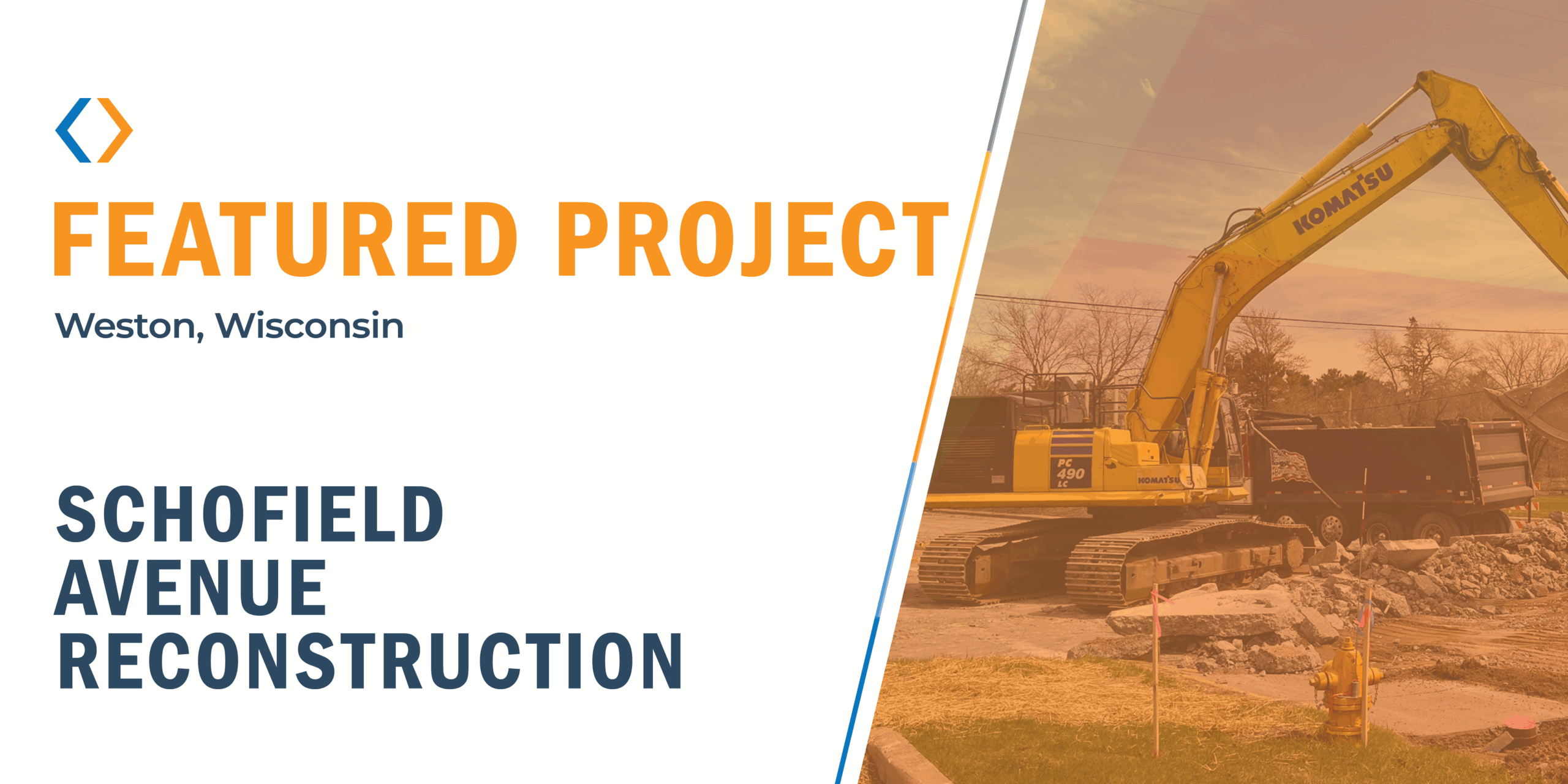


The Village of Weston, WI, has completed a transformative reconstruction of just over 1 mile of Schofield Avenue, one of the region’s busiest and most visible commercial corridors. With concrete pavement more than 35 years old and showing signs of failure, the Village sought to reconstruct the roadway, improve safety, enhance its landscaped medians, and upgrade aging water and sanitary sewer mains.
Clark Dietz served as lead design engineer and provided full construction management and observation services. The project was managed by Tonia Westphal, PE, LEED AP, with traffic design support from JT Engineering and survey services from Riverside Land Surveying.
A Complete Corridor Transformation
The project began as a pavement rehabilitation effort but quickly evolved into a full-depth reconstruction after field reviews revealed widespread concrete distress and the need for more extensive curb and gutter replacement. The four-lane arterial roadway required reconstruction of pavement, curb and gutter, driveway approaches, and multiple utility systems, including sanitary sewer, water main, and storm sewer infrastructure. Three signalized intersections were updated with new traffic signals and improved geometry.
Pedestrian safety enhancements were another key component. The project delivered ADA-compliant ramps and mid-block Rectangular Rapid-Flashing Beacons (RRFBs), providing safer crossings along a corridor known for heavy traffic volumes.
Complex Concepts Understood: Rectangular Rapid-Flashing Beacons (RRFBs)
Rectangular Rapid-Flashing Beacons (RRFBs) are small, rectangular LED lights that flash quickly to grab drivers’ attention at crosswalks. They turn on when someone pushes a button (or when a sensor detects a pedestrian) and help make people crossing the street more visible, especially in spots without traffic signals.

The roadway’s landscaped medians, lined with mature trees, lighting, and stamped/colored concrete, required special care. While the construction team replaced curb, gutter, and decorative concrete, Weston’s Parks and Public Works Departments worked simultaneously on irrigation upgrades and landscape restoration, refreshing the appearance of the Village’s signature commercial corridor.
“This is the Village’s most prominent corridor,” Tonia said. “The work completed here will have a lasting impact on access, aesthetics, and overall mobility for residents and businesses.”
A One-Season Construction Effort
Construction took place from April through November 2025, an aggressive timeline for a corridor of this size and complexity. Completing all work within one construction season required extensive coordination across engineering teams, contractors, and Village staff.
Traffic control became one of the project’s most important challenges. Instead of relying on a fixed traffic control plan, the team met weekly to review current conditions, upcoming construction activities, and business access needs. Mail routes, garbage service, school buses, and general customer traffic were carefully considered each week.
The Village shared weekly public updates to keep businesses and residents informed. Despite the scale of the work, community feedback remained overwhelmingly positive.
“The flexible, collaborative traffic management approach allowed the project to stay on schedule while keeping the business corridor functioning,” Tonia said. “That was a huge success.”
Infrastructure Improvements Backed by Planning

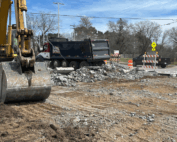
Pavement in front of Target entrance
Some of the sanitary sewer work completed under Schofield Avenue was informed directly by Clark Dietz’s Sanitary Sewer Master Plan for the Village. Incorporating recommendations from the plan ensured that long-term infrastructure needs were addressed while the roadway was already open.
Storm sewer improvements, including targeted flood mitigation near the Target retail area, were also completed to strengthen system performance.
The project received support from Wisconsin’s Local Road Improvement Program (LRIP), helping the Village invest in a corridor crucial to its economic activity.
A Collaborative, Client-Focused Approach
Consistent communication and partnership guided the project from early design through final construction. As the scope expanded from resurfacing to full reconstruction, the project team worked closely with Village staff to evaluate options and select the most effective long-term solution for the community.
“We see ourselves as an extension of our clients’ staff,” Tonia said. “Our role is to advise, present alternatives, and work side-by-side as our Clients make the best decisions for the community.”
A Stronger Corridor for the Village of Weston
With construction now complete, Schofield Avenue has emerged with:
- Durable, modern pavement
- Upgraded utilities and infrastructure
- Improved traffic operations and new signals
- Safer pedestrian crossings
- Restored and enhanced landscaped medians
The result is a revitalized commercial corridor built to serve residents, businesses, and visitors for decades to come.

Questions? Contact Project Manager, Tonia Westphal, PE, LEED AP.