

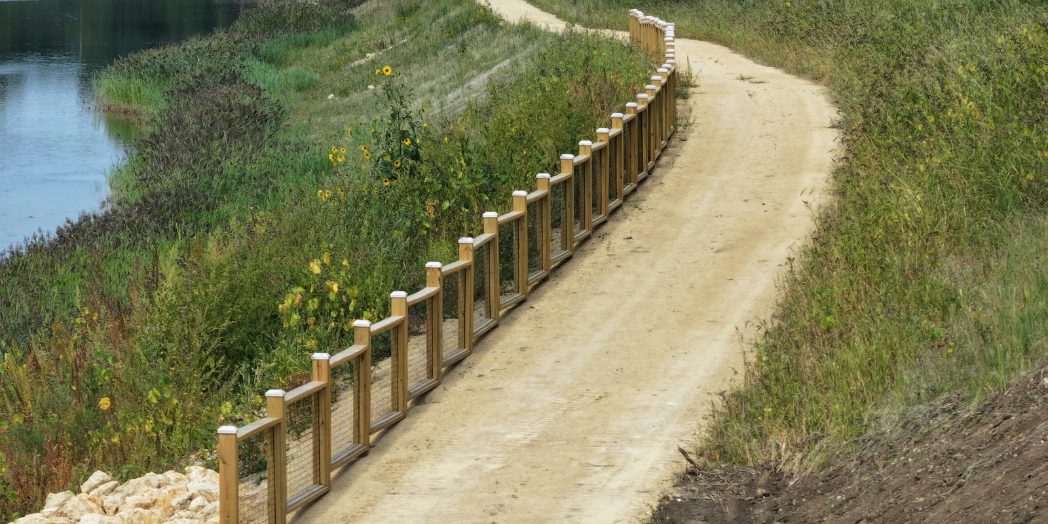
When the City of Crystal Lake, IL, revived its vision for a trail encircling the lake at Three Oaks Recreation Area, it wasn’t just about connecting pathways; it was about connecting people to a beloved natural space. The resulting 2.5-mile walking path would provide new opportunities for exploration and recreation in the city once complete.
But for the engineers tasked with bringing this long-shelved idea to life, it was no easy stroll.
“This was a challenging design,” said Clark Dietz Project Manager, Antonio Acevedo, PE. “We were trying to build a flat plane on very steep slopes, and that can be tough to do.”
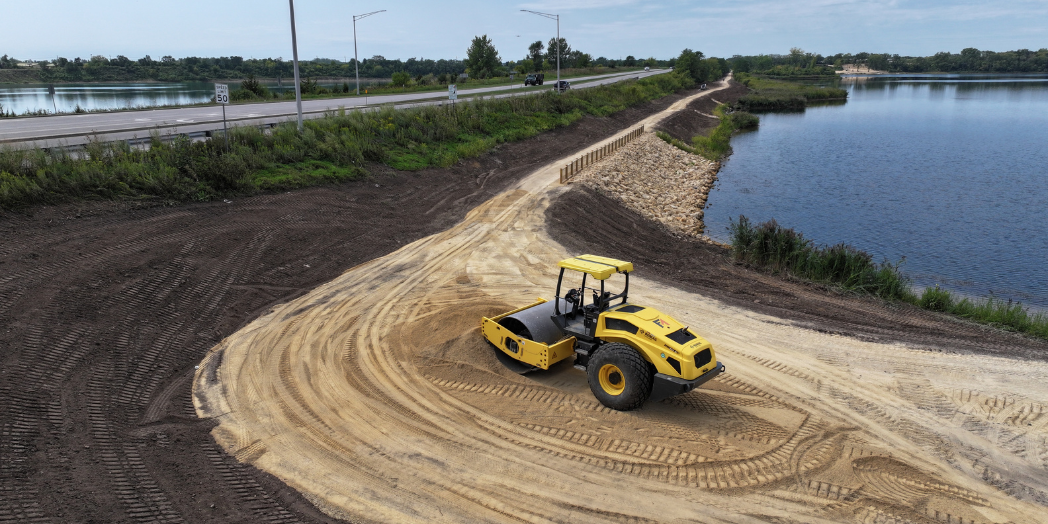
Preconstruction at site meeting
A Vision Years in the Making
The city had dreamed of a full trail around Three Oaks since the recreation area opened more than a decade ago. Early cost estimates for construction came in too high, and the project was put aside. When funding became available, the city was able to move forward with the project and Clark Dietz was selected.
“It was challenging project from a design perspective,” Antonio said. “But we were able to complete it on time and on budget, so it’s been a great project from start to finish.”
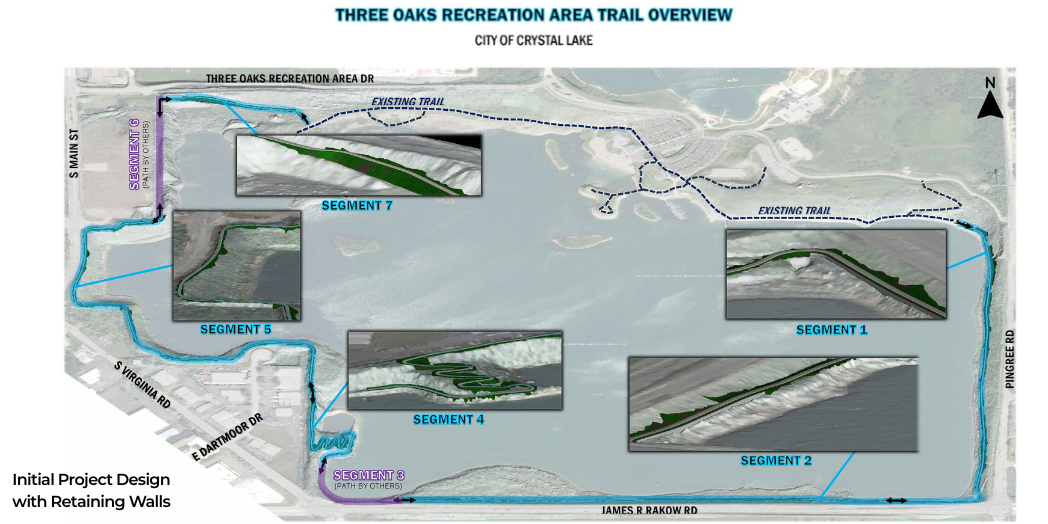
The team designed 2.1 miles of new trail segments (part of a future 2.5-mile loop), tying into existing paths at the recreation area. Additional sections are being built through a concurrent stormwater project and nearby residential development. In total, the loop consists of seven segments, of which Clark Dietz designed five.
By next summer, the city expects the entire trail to be open.
Design Challenges
From the start, the topography posed hurdles, as much of the lake is lined with steep wooded slopes.
“At first, we designed it with retaining walls for half the length,” Antonio said. “In some cases, there needed to be 10- to 15-foot-high walls, and the city had concerns with constructability and cost. So, through a value engineering process, we reanalyzed everything and were able to eliminate the retaining walls by adjusting the trail horizontally and vertically and changing the design criteria to focus on pedestrians instead of bicycles.”
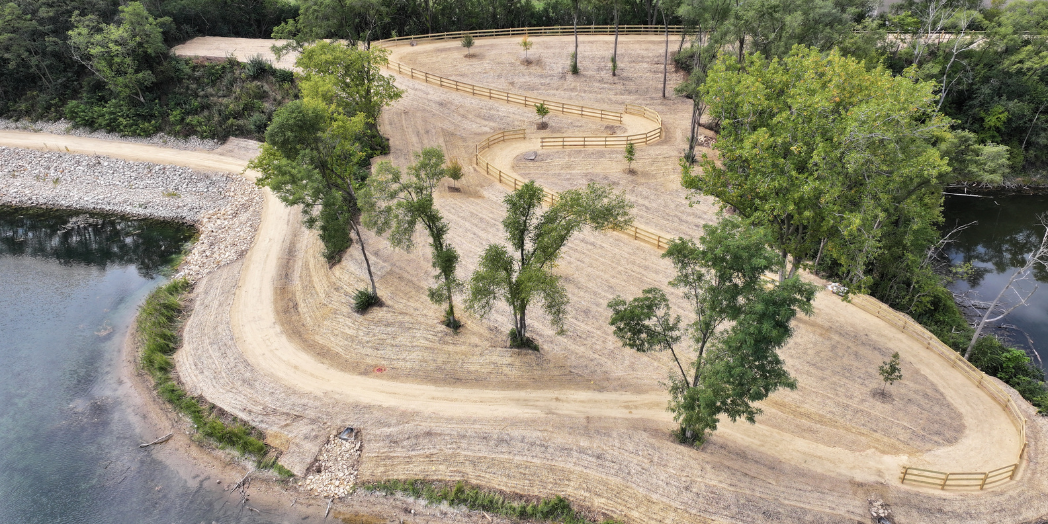
Segment 4 switchback
The team went back to the drawing board. Instead of walls, they stabilized the slopes with geo-grid and riprap. The redesign eliminated all retaining walls, making the project both more affordable and more natural in appearance.
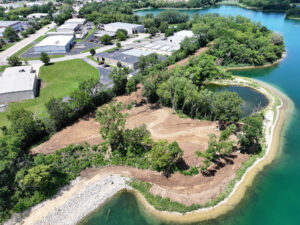
Segment 4, one of the steepest sections, required special creativity: a 35-foot vertical climb from lakeshore to ridge. The team initially designed a winding switchback to meet ADA accessibility standards. However, it was discovered that the terrain was less severe than it appeared through the trees, and the design was adjusted again to simplify the climb and preserve additional trees.
Sustainable by Design
Beyond accessibility and cost, sustainability guided the project at every step.
- Instead of concrete or asphalt, the trail surface uses a crushed granite/limestone mix, which is durable, low-impact, and easy to maintain.
- More than 30 native trees and diverse prairie grasses are being planted to restore habitats, improve biodiversity, and reduce long-term maintenance.
- Construction access routes were designed not only for heavy vehicles but also as future emergency access points, promoting long-term safety.
“We included native planting, so there will be prairie grasses instead of standard roadside, non-native grasses,” Antonio said. “It’s environmentally sustainable.”
The approach also allowed the team to save mature trees within the switchback area wherever possible. “Originally, we anticipated removing all of the trees, but we were able to redesign and avoid some of the more mature trees,” Antonio explained.
Bringing the Design to Life in 3D
Another critical component for the Clark Dietz transportation team was the use of Bentley OpenRoads Designer.
Engineers Ronald Nordmeyer and Matthew Mote, EI, led much of the design effort. “They really deserve the credit for this project,” Antonio said. “They did the bulk of the design and figured out how to make it work.”
Reflecting on the design process, Ronald described the challenges they faced:
“The project site featured rough terrain with steep slopes along a lakeside, making design visualization especially challenging. When the client reviewed our traditional flat drawings of the concept trail, they had questions from every angle about how the design fit the landscape. To address this, we presented a 3D model of the trail projected onto the terrain, which instantly clarified the concept and eliminated the need to revisit the flat drawings. The 3D model not only resolved all design concerns but also powerfully communicated the vision in a way that flat drawings simply couldn’t. It sold the concept to the client, and when images from the model were shared with the council, it sold the design again, securing their full support.” – Ronald Nordmeyer
A Trail for the Community
Even with the challenges the project presented, the team found it immensely rewarding. “It was challenging, but it was fun,” said Antonio. “I’m hoping we get more of these types of projects because they’re difficult, but still enjoyable to work on, and who doesn’t like trails?” That enthusiasm shines through in every aspect of the trail, from the initial concept to the final construction.
Beyond recreation, the trail serves as an important environmental and educational resource. Thoughtful design choices, including sustainable landscaping and preservation of natural areas, highlight the region’s local ecology while creating a space for people to learn about and engage with nature. The project reflects a commitment to enhancing the quality of life in Crystal Lake.
Segment 1 preconstruction
Segments 3-5 preconstruction
Segment 6 preconstruction